- 03-16-2026
- 0
Garden Irrigation Systems and Their Importance for Plants
What is garden irrigation?
Garden irrigation is the artificial application of a certain amount of water to the soil in order to support plant growth and maintain greenery.
The importance of garden irrigation
Whether you are a gardener or someone working in a field related to garden maintenance, an irrigation system is a valuable investment. Regardless of the size or shape of your property, a quality garden irrigation system is an essential maintenance factor.
• Ideal level – Installing an irrigation system makes it possible to provide the amount of water necessary for proper root development of plants.
• Important role in plant growth – With a proper water supply system, plants can absorb mineral nutrients from the soil, which makes garden irrigation extremely important for the overall growth of plants.
• Continuous agriculture – Agriculture often faces major difficulties due to irregular or unpredictable rainfall. Proper irrigation systems can ensure continuous watering of agricultural crops.
• Increased productivity – By using a reliable irrigation system, the productivity of irrigated land becomes higher than that of non-irrigated land. Worldwide, productivity in irrigated areas is higher than in areas that rely only on rainfall.
Main types of garden irrigation
Basically, there are three different types of garden irrigation: 1. manual watering, 2. sprinkler watering, 3. garden irrigation system.
1. Manual watering
This is the traditional watering method that everyone knows. This method involves using either a watering can or a garden hose. If done correctly, this watering method can be practical and effective.
The advantage of manual watering is that you can determine whether the plant needs water and how much water it needs.
If you use manual watering, you can achieve higher efficiency by using the following methods:
• Use a spray nozzle with an attachment — this will help minimize water waste.
• Use the lift test. A simple way to check whether a plant needs water is to lift the pot. Over time, you will know how heavy the plant should feel when it has enough water; if it feels too light, it needs watering.
Obviously, this cannot be done with plants growing in the soil, so you can use a moisture meter instead.
• Do not rush. Water that does not reach the plant roots is wasted, so slower and lighter watering is more effective. The main point is to ensure that water reaches the roots.
2. Sprinkler watering
In this case, the sprinkler device is placed in the center of the area to be watered and connected to a water source via a garden hose. There are several types of sprinklers depending on their purpose:
• Rotating sprinkler. Rotating arms spin clockwise and create a circular spray of water. It is very popular and available in many garden centers. Some models can be adjusted depending on the size of the area.
• Oscillating sprinkler. Here the head of the device slowly rotates from side to side. It provides watering of the area with a rectangular spray pattern.
• Impact sprinkler. This type is designed for larger areas. They are usually the choice of professional landscape designers.
• Traveling sprinkler. This is a type of rotating sprinkler that moves along a predetermined path. The spray pattern may be uneven, but it is ideal for reducing the time required to water large areas.
• Sprinkler hose. This is a flattened hose with a series of small holes along the upper length.
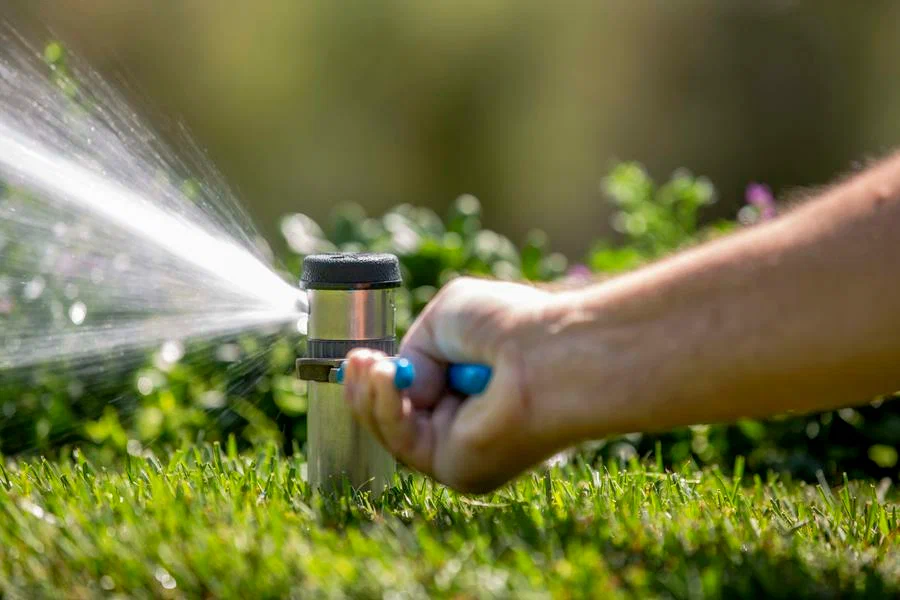
• Pop-up sprinkler systems. Underground sprinklers are visible only when the system is active. They can be controlled by a computerized timer.
3. Automatic irrigation systems
As the name suggests, these are automated irrigation tools. When installed correctly, they can be more efficient than other irrigation methods.
There are many types to choose from, and each has its own method of use:
• Drip irrigation. In this type, emitters slowly release water and allow the root zone of the plant to be fully soaked without runoff and waste. You can automate this tool by connecting it with an automatic water timer.
The drip irrigation system is ideal for borders, flower beds, and vegetable areas. Compared to using a garden hose, you can reduce water consumption by up to 80%.
• Micro spray systems. These are a common choice for gardens because they take little time to install and can cover many plants with a single spray.
Each spray can distribute water within a radius of up to 2 meters. They can also be automated using a water timer.
• Mini sprinkler systems. Similar to micro sprinkler systems, these are placed above the ground and used to cover larger areas.
Mini sprinklers can cover areas with a radius of up to 5 meters. With this type, you can also use a water timer to plan irrigation cycles.
• Pop-up sprinkler systems. Fully underground installed pop-up sprinklers appear only when the system is active and retract back into the ground after watering is completed.
Pop-up sprinklers promise better plant coverage and are more efficient. By using an electronic water timer, you can fully automate the activation of the pop-up sprinkler system.
Advantages of smart garden irrigation systems
• Reduces your workload – eliminates daily tasks such as manual watering and helps free up extra time for other activities.
• Ensures even distribution – provides consistent and balanced water distribution, resulting in healthier plants and increased productivity.
• Increases efficiency – helps reduce water costs by limiting water waste.
• Supports healthier plant growth – protects plants from overwatering or underwatering.
• Relax with automation – install it and forget it, while enjoying the convenience of an automated system.
Effective garden watering tips
• Pay attention to plant roots. The roots of the plant need water, not the leaves, so focus more on feeding water to the roots rather than wetting the leaves.
• Water only when necessary. There is no strict rule about how much water is required. It completely depends on the season, soil, plant type, and weather conditions.
Pay attention to the weather and adjust the watering frequency accordingly. Too much water can be just as harmful as too little.
• Water in the morning. Watering in the morning allows any moisture left on the leaves to dry and prevents plant diseases from spreading in your garden.
The earlier, the better. The next best time for watering is late afternoon so that plants have enough time to dry before nightfall.
• Mulch everything. Mulch is a material used to retain moisture and prevent weeds.
• Use the right tools. Using the right tool for the job will help you water more easily.
Conclusion
Thus, garden irrigation plays an important role in the healthy growth of plants and increasing productivity. A properly selected and installed irrigation system according to the needs of the property can help you understand the needs of plants and increase efficiency while reducing costs.
At the same time, by knowing specific details such as when plants should be watered, you can increase their lifespan, and by using automatic irrigation systems you can manage the garden area more efficiently.
As a result, carefully planned irrigation is a key factor that increases the longevity of plants and the productivity of the garden.