
- 09-10-2026
- 0
How to choose the right tool for pruning trees and shrubs
“The right tool for the job” is more than just an old saying. It is especially true when it comes to pruning trees. Using the wrong tool or applying it incorrectly can seriously damage a tree and may even cause injury to you.We recommend that all major tree work be carried out by a certified arborist. However, some homeowners prefer to handle smaller pruning tasks themselves. To help you achieve the best results, this article explains which pruning tools are suitable for different tasks, what features to consider when choosing them, and which safety precautions you should follow.
Pruning Tool Basics
The first thing to consider when purchasing or using any tool for tree care is its quality.
A high-quality tool does not necessarily have to be expensive. However, cheap pruning tools are often weaker and lighter versions of standard professional tools.
Low-cost pruning and tree-care tools often use:
Plastic components instead of metal;
Low-quality cast metal or alloys instead of steel;
Cast steel instead of forged steel.
When choosing a tool, consider the tasks you intend to perform and the amount of force required to complete them.
Investing in a high-quality pruning tool is a relatively small expense compared with the risk of a cheap tool breaking, potentially injuring you or damaging the tree, and then needing to be replaced.
High-quality tools also require regular maintenance.
Cutting blades should be sharpened after every use. All debris and sap should be removed, and metal components should be properly lubricated.
If you plan to store your tools for an extended period, they should be thoroughly oiled to prevent rust and the mechanisms from becoming stuck.
If you are unable to purchase high-quality tools or do not have a suitable place to store and maintain them, hiring an insured, qualified, and trained tree-care professional may be a more cost-effective and safer option. Such professionals already have the necessary equipment for the job.
Which Pruning Tools Should You Use?
You have probably, like many other people, used a tool for a task it was not specifically designed for. In many situations, this may work without any problems.
However, when it comes to tree pruning, the risk of injury is too high to justify improvising or using tools incorrectly.
Pruning tools are specifically designed for particular tasks, and every tool has limitations. Applying excessive force or using a tool incorrectly can damage both the tool and the tree and may also cause injury to the user.
From small pruning tasks to larger jobs, the most commonly used pruning tools include the following.
Hand Pruners
Hand pruners are also commonly known as garden clippers, secateurs, or hand shears.
As one of the most common gardening tools, hand pruners:
Are used for making small cuts on soft and woody plant material, as well as for precise aesthetic pruning;
Usually indicate on the packaging the maximum branch diameter they can cut, typically around ½ to ¾ inch;
Can feature bypass blades, which operate like scissors and are generally a better choice for cutting live wood than anvil blades;
Are available in a variety of designs to suit different hand sizes, including models designed for left-handed users.
Loppers
If you need to cut thicker branches, do not force your hand pruners beyond their limits. Instead, use loppers.
Loppers are long-handled pruning tools that:
Look similar to hand pruners but have longer handles;
Can generally cut branches up to approximately 1½–2 inches in diameter;
Have wider-opening cutting blades and provide greater cutting force.
As with hand pruners, it is recommended to choose loppers with bypass blades rather than anvil blades.
Anvil blades are much more likely to crush stems and branches instead of making a clean cut. This can increase the likelihood of damaging the tree's living tissue.
Pruning Saws
When branches are too thick for hand pruners or loppers, or when a branch is difficult to reach with a scissor-type cutting tool, a pruning saw is the better choice.
Pruning saws:
May have a fixed, open blade or a folding design that allows the blade to be enclosed inside the handle;
Some models have multiple locking blade positions, which can be useful when working in difficult-to-reach areas;
Usually indicate on the packaging the maximum branch diameter they can cut;
Come with different tooth sizes. Coarse teeth are generally suitable for larger branches, while fine teeth are better suited to smaller branches;
Can generally cut branches between approximately 2½ and 3 inches in diameter.
Note: A bow saw is also a type of pruning saw, but it is designed for cutting much larger branches and is often used to cut logs for firewood.
Pole Saws and Pole Pruners
If you need to cut branches that are out of reach, you can use a telescoping pole saw or pole pruner.
Pole pruning tools may:
Have scissor-type cutting blades, similar to hand pruners, at the end of the pole. These can be operated using a cord, lever, or pistol-style grip;
Have a fixed blade similar to a pruning saw, which is operated like a traditional hand saw.
Because of the distance between the person standing on the ground and the blade at the end of the pole, as well as the physical strength required to hold the tool while cutting, pole tools often produce less precise cuts.
You may also be unable to cut branches at the maximum diameter specified for the tool.
Keep in mind that branches at height can move while you are cutting them because you do not have an additional hand available to stabilize the branch.
When pruning above shoulder height, always wear a hard hat and eye protection to protect yourself from falling branches, sawdust, and other debris.
A heavy branch that unexpectedly breaks loose and falls can cause serious injury. Falling debris and sawdust can also cause significant eye injuries.
Note: High branches can sometimes be pruned using hand tools while standing on specialized ladders, such as tripod or orchard ladders used by trained tree-care professionals.
However, homeowners are strongly advised not to attempt this.
Falling from a ladder can result in serious injury or even death. Whenever possible, perform pruning from the ground or, at most, use a short step ladder that is securely held by another person.
Powered Pole Saws and Pole Pruners
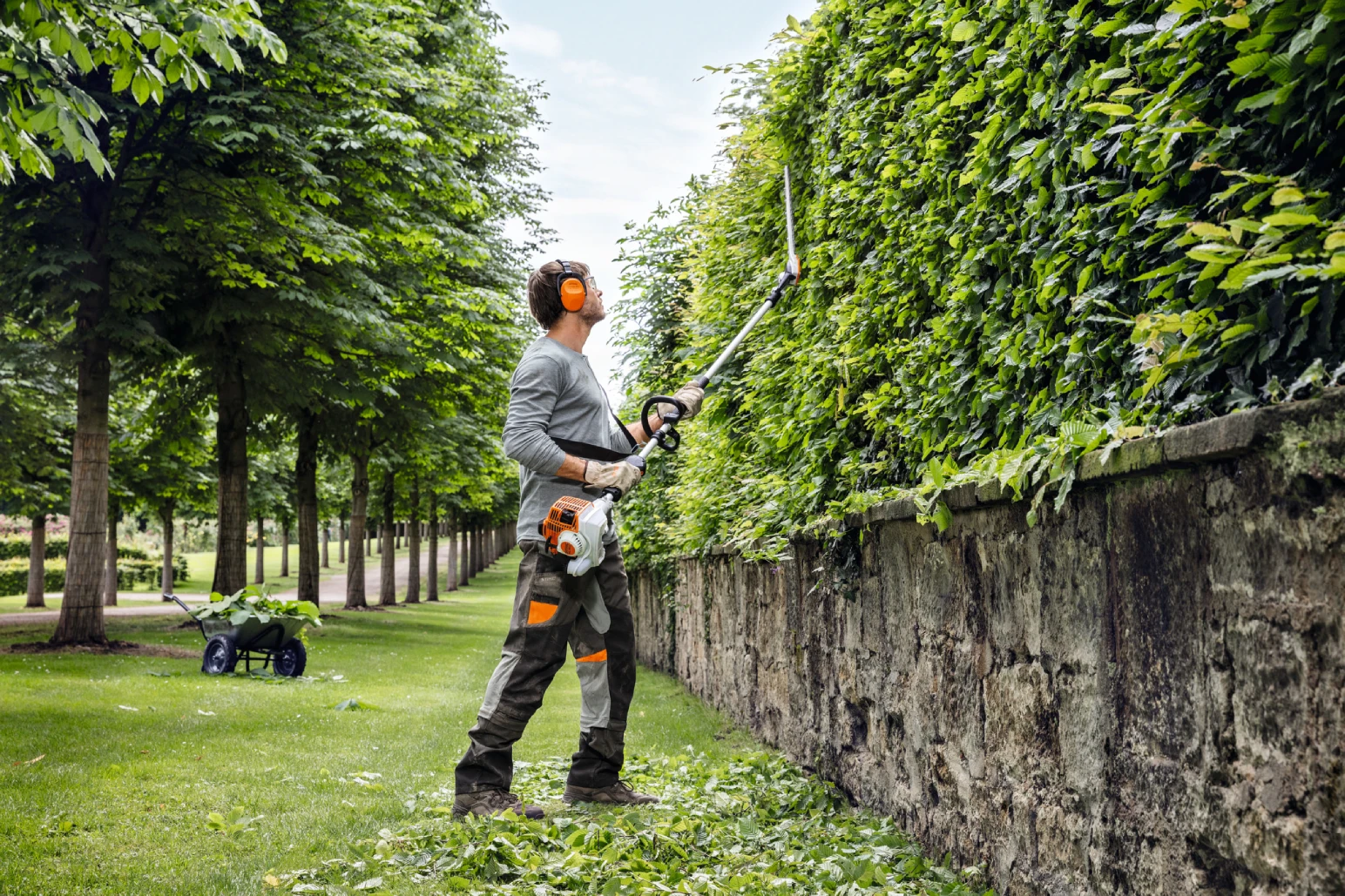
Powered pole pruners may use a battery, electrical cable, or gasoline engine to operate a moving cutting blade at the end of the pole.
For most powered pole pruning tools:
The telescoping pole is generally 8–10 feet long;
The working height is determined by the length of the pole plus the user's arm length;
The user must also have sufficient physical strength to hold the tool, as some models can weigh up to 20 pounds;
Depending on the model and manufacturer, powered pole pruners may cut branches from approximately 2 to 8 inches in diameter;
In addition to the power source, the length of the cutting bar also determines the maximum branch diameter the tool can cut.
Note: All types of powered pole pruners produce noise and vibration. Some tools can weigh up to 20 pounds, while motorized blades operate much faster than manually operated cutting tools.
For this reason, safety precautions and appropriate protective equipment are especially important when using powered pruning tools.
Before purchasing or using a powered pole pruner, always carefully read the manufacturer's instructions and specifications.
Keep in mind that:
Corded electric pruners limit how far you can move from an electrical outlet;
The amperage affects the maximum cutting diameter;
Battery power determines the maximum performance of the cutting blade;
The size of a gasoline engine determines the tool's maximum cutting power.
Chainsaws
Chainsaws are large, powerful, and potentially dangerous tools used to cut and remove large branches and tree trunks.
Professional tree-care specialists receive specialized training in chainsaw operation, tree climbing, and safely securing and lifting chainsaws with ropes.
Because of the significant risk of injury and tree damage, homeowners are not advised to use either electric or gasoline-powered chainsaws — whether working from the ground or from within a tree.
If you need to remove large branches or cut through a tree trunk, it is safer and more effective to contact a professional tree-care specialist.
Conclusion
Choosing the right pruning tool not only makes the job easier but also helps protect the health of the tree and ensure the safety of the person performing the work.
For small branches, hand pruners are usually sufficient. Thicker branches may require loppers or a pruning saw, while pole tools can be used for branches that are difficult to reach from the ground.
However, when dealing with large branches, tall trees, or chainsaws, it is safer to leave the work to a trained professional.